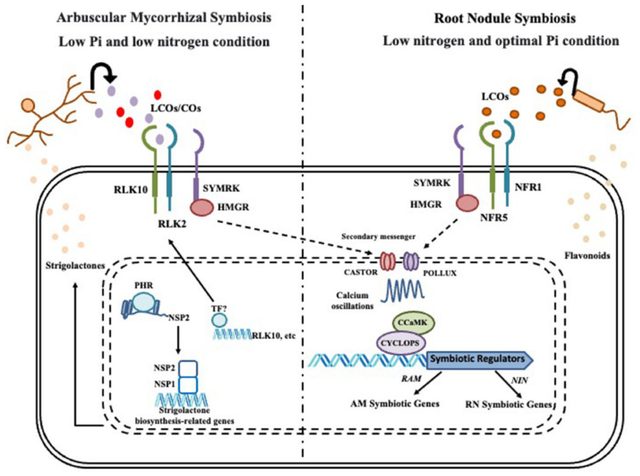
Perspective article framing phosphate as a metabolic checkpoint for root nodule symbiosis. Proposes that the PHR-L7–NIN–TML axis translates Pi status into symbiotic commitment. N, Pi and Fe signalling are integrated at the NIN locus.
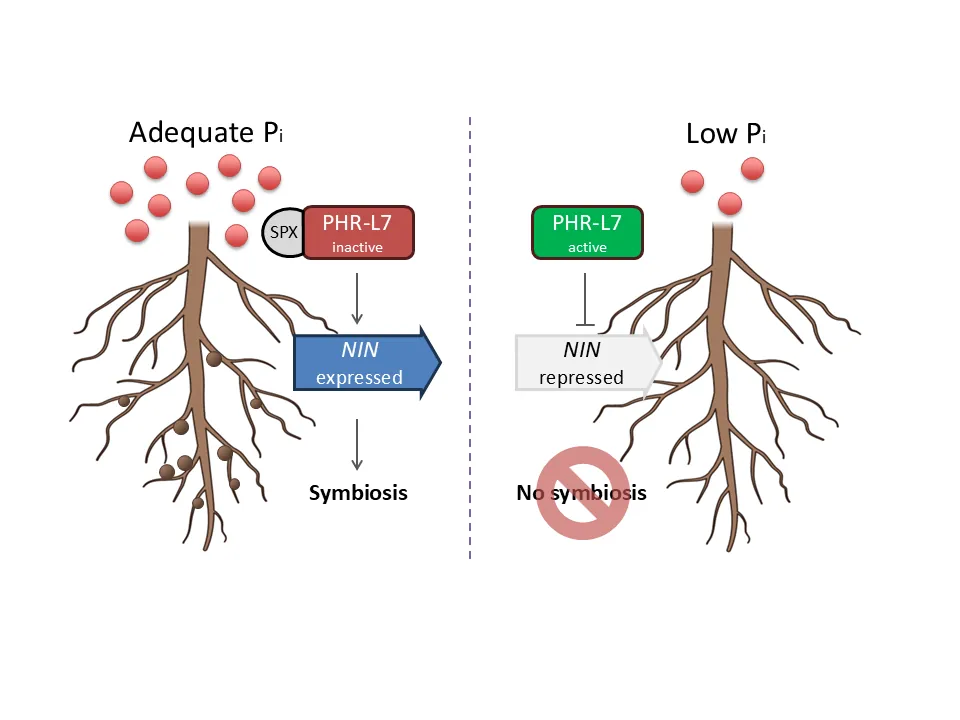
Under adequate phosphate, SPX holds PHR-L7 inactive and NIN is expressed, enabling symbiosis. Under low phosphate, PHR-L7 becomes active, binds the NIN promoter, and fewer nodules form.
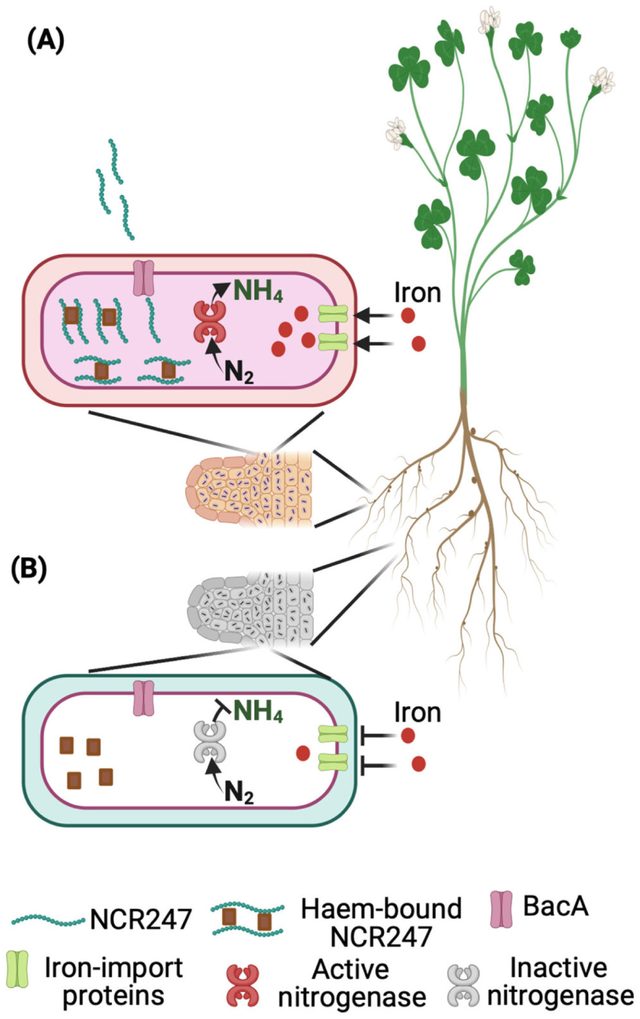
Commentary on how the SOLE cis-element hardwires the signal peptidase complex (DNF1/SPC22, SPC18) into the nodule programme, with NIN as candidate regulator.
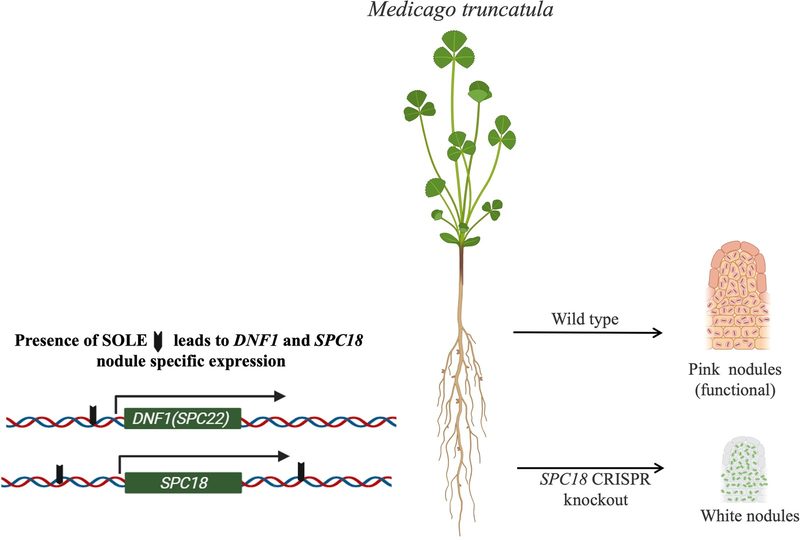
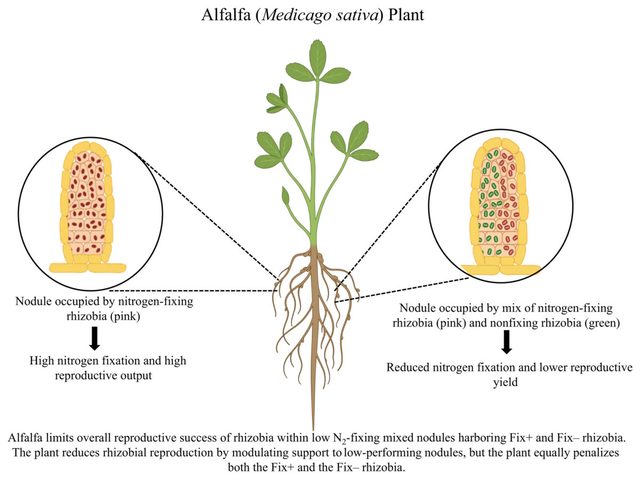
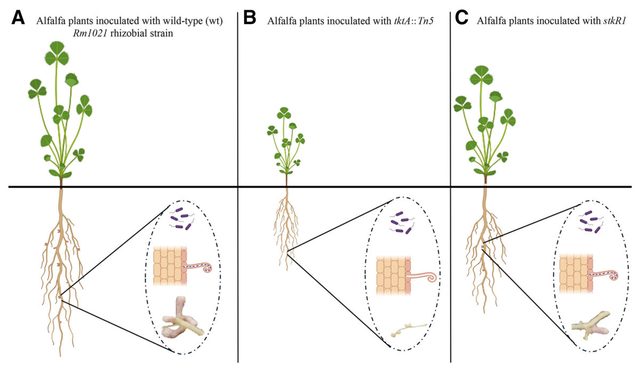
The SOLE element switches on DNF1 (SPC22) and SPC18 specifically in nodules. Wild-type plants form pink, nitrogen-fixing nodules; CRISPR knockout of SPC18 gives white, non-functional ones.
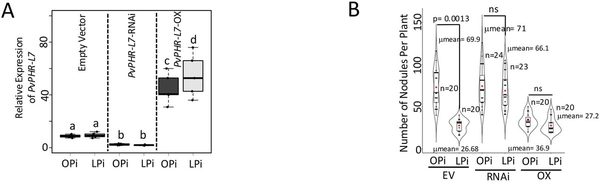
First demonstration that the phosphate starvation response transcription factor PvPHR-L7 directly binds the promoters of NIN and TML in common bean. RNAi increased nodulation; over-expression reduced it. This identifies phosphate signalling as a metabolic checkpoint for root nodule symbiosis.
PvPHR-L7 RNAi increases nodulation, while over-expression decreases it, in common bean.
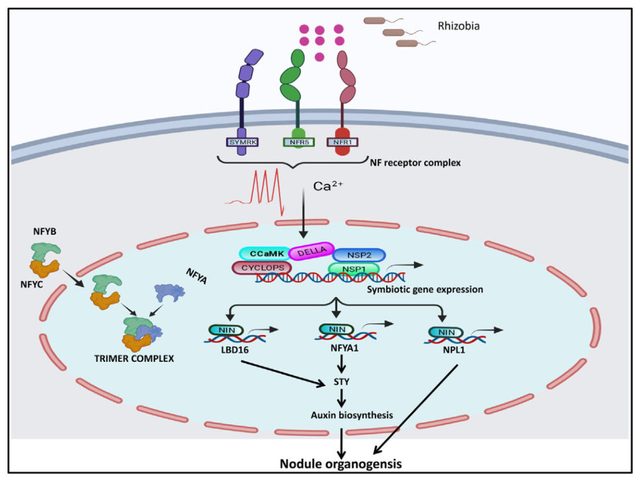
Identified and characterized 17 LysM receptor-like kinases in the chickpea genome and showed that RNAi knockdown of CaNFP and CaLYK3 reduces nodulation. This establishes the receptor toolkit for Nod-factor perception in a non-model crop legume.
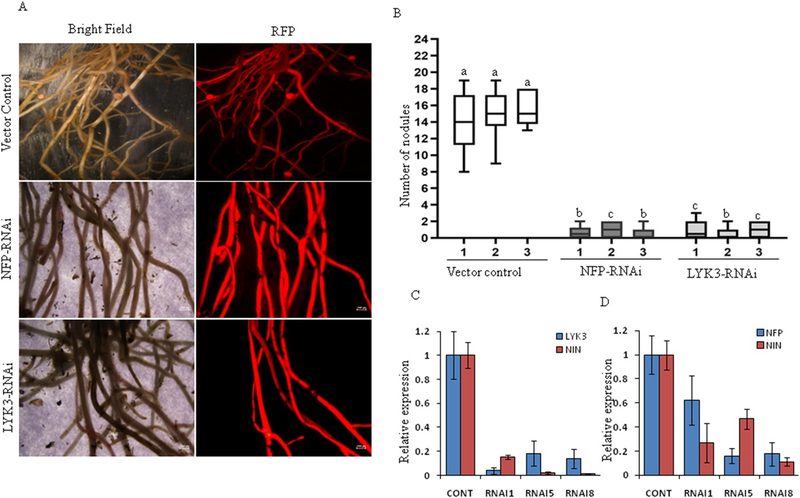
Vector-control chickpea roots form many nodules, whereas NFP-RNAi and LYK3-RNAi roots form almost none (A, B); NIN expression falls in the knockdown lines (C, D).
Perspective article framing phosphate as a metabolic checkpoint for root nodule symbiosis. Proposes that the PHR-L7–NIN–TML axis translates Pi status into symbiotic commitment. N, Pi and Fe signalling are integrated at the NIN locus.
Commentary on how the SOLE cis-element hardwires the signal peptidase complex (DNF1/SPC22, SPC18) into the nodule programme, with NIN as candidate regulator.
Singh, J., Mendoza-Soto, A. B., Tiwari, M., Acevedo-Sandoval, T. T., Formey, D., Ané, J. M., Isidra-Arellano, M. C., & Valdés-López, O.
Plant and Cell Physiology, 2025, 66(12), 1794–1810
First demonstration that the phosphate starvation response transcription factor PvPHR-L7 directly binds the promoters of NIN and TML in common bean. RNAi increased nodulation; over-expression reduced it. This identifies phosphate signalling as a metabolic checkpoint for root nodule symbiosis.
Environmental and Experimental Botany, 2022, 202, 104999
Identified and characterized 17 LysM receptor-like kinases in the chickpea genome and showed that RNAi knockdown of CaNFP and CaLYK3 reduces nodulation. This establishes the receptor toolkit for Nod-factor perception in a non-model crop legume.